
Sao Paolo
- Introduction
- Official opening of the Seminar
- Cultural Rights: a new framework for cultural management
- Cultural Rights: the underdeveloped side of human rights (global and local initiatives)
- Towards a Right to Cultural Identity in International Human Rights Law
- South, Cultural Diversity and Beyond
- Diversity: between identity and citizenship
- Preliminary observations
- Human Rights � Cultural Rights: The right to take part in cultural life
- Charter on Cultural Rights and Commitments of the citizen of Barcelona
- E agora, Jos�. Presentation of the Forum Cultural Mundial of Sao Paolo
- UNESCO International Convention on Cultural Diversity
- Agenda 21 for Culture
- Circle of reflections and preliminary results
- Annex 1
- Annex 2
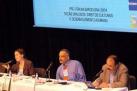
Official opening of the Seminar
9. The official opening session started with an address by Dr M�nica Allende Serra, President of Arte Sem Fronteiras (ASF), who started by thanking the co-organizers, Interarts Foundation and the Universal Forum of Cultures Barcelona 2004, as well as the Inter-American Development Bank, UNESCO, Organisation of Ibero-American States for Education, Science and Culture and SESC Sao Paolo, in the premised of which the forum was held. She welcomed the participants to a fruitful dialogue and called for practical outcomes and implications in this third and final seminar in the series of seminars organised by ASF in Latin America under the title of Culture and Public Policies for Development. She underlined that �similar to the acknowledgment of the importance of environmental diversity to the generation of richness and prosperity, cultural diversity is one of the supporting pillars of the economies of development.� She also stressed assistance cooperation, the linkage between economic development logic and ethic principles, and the capacity of each citizen to take responsibility of self and community without relying solely on initiatives of public administration.
10. International Association Arte Sem Fronteiras (ASF) aims at promoting the role of culture in development processes in the region and creating conditions for cultural action in order to produce practical implications of that aim. The goal is to place culture in a central place together with the economic and social sectors. ASF wants to foster the creation of integration for the Latin American thought through critical examination of cultural diversity preservation strategies. Through its actions, ASF underlines the necessity to come up with practical implications of articulation of cultural rights on local, regional and international level.
After Dr Serra�s speech, Quarteto Amaz�nia interpreted Astor Piazzolla�s tangos.
11. The Secretary for Culture of the State of Sao Paolo, Claudia Costin welcomed the seminar and all the international experts, and called for practical implications of cultural intervention in daily-life conflict situations. She underlined cultural intervention in problems related to the region, especially crime-related urban violence. She listed as positive examples projects in low-income areas of Sao Paolo where social projects have been able to offer alternative lifestyles to young people to whom gang- and crime-related violent environment has many times offered the only exit of poverty.
12. Jos� Mindlin, member of the ASF Board, underlined the importance of encounter and dialogue, and emphasized cultural acceptance and cooperation as ways towards a better understanding between people. Choosing spontaneous speech instead of a written one, he praised the importance of listening to different views and opinions, and the importance that culture and expression has to the well-being of everyone. He underlined the role of ASF in creating spaces for art without prejudgements and cross-frontier collaboration.
13. Danilo Santos de Miranda, director of SESC welcomed everyone to the premises of SESC and to Sao Paolo where the World Forum on Culture would take place within a couple of months. He stressed the objectives of the coming Forum and examined the concept of diversity. He also underlined the importance of holding the seminar in Sao Paolo and the implications the outcomes could have in relation with the World Forum of Culture.
14. Rita Sorio, representative of the Inter-American Development Bank, thanked all the organisers and underlined the commitments that her organisation has with culture. She underlined that acknowledging and respecting diversity forms part of the fundamental objectives of the Bank, and that is has a long history in supporting arts and cultural expressions in the Latin American region. She also thanked ASF for the series of seminars that they have organised, and stressed the importance of the outcome of this seminar.
15. Jurema Machado, representative of UNESCO Brazil thanked the organizers for making the seminar possible and called the participants for a rich dialogue. UNESCO Brazil has a permanent partnership with Arte Sem Fronteiras, which plays an important role on disseminating UNESCO�s principles and ideas. Dr Machado underlined that ASF does that in a regular, continuous and consequent way.
16. Daniel Gonzalez, representative of OEI, the Organisation of Ibero-American States for Education, Science and Culture thanked the organising partners and underlined the importance of examining diversity and cultural rights in the Latin American context. He expressed the interest of his organisation of being involved in the elaboration of ideas and initiatives concerning the importance of culture in development and in the well-being of communities.
17. Alfons Martinell de la Fundaci�n Interarts va agrair a l�organitzaci� i al F�rum Cultural Mundial haver fet possible aquest seminari i va destacar la import�ncia de la integraci� dels drets humans, incloent els drets culturals, en el disseny de totes les pol�tiques p�bliques. Es va referir a la s�rie de seminaris organitzada per ASF i va destacar la import�ncia d�estudiar la diversitat i els drets culturals en el context llatinoameric�. A m�s a m�s, va posar �mfasis en la import�ncia de cobrir el �gap� entre les pol�tiques p�bliques i els drets humans per facilitar la governabilitat que fomenta la dignitat humana i la no discriminaci�.
Key-note speech: Commentaries on Cultural Rights in Latin America
18. The keynote speaker of the inauguration was Juan Luis Mej�a, former minister of culture of Colombia. He started by referring to the work of Jes�s Prieto de Pedro who acknowledges three pillars that form the basis of the development of cultural rights. The first pillar is the author�s right, that represents some of the previous legislations and follows the international legal framework marked by the Convention of Bern from 1886. The second pillar is the legislation related to cultural heritage and including museums, libraries and archives, and the third related to cultural industries deriving from the legislation of printed media that most of the constitutional states adopted along the 19th century. Within the structure of legal development, the intellectual property rights are the eldest and the ones that �most jurisprudence and doctrines have generated� as well as international frameworks. Dr Mej�a reminded that cultural rights belong to the second and third generation human rights that require an active role from the state in order to guarantee their enjoyment, but also an international action to safeguard development, peace and protection of environment.
19. Dr Mej�a indicated that the first Latin American references to cultural rights were linked to intellectual property rights or author�s rights, as they are known today. The first legal action is the 1834 Chilean law on literary and artistic property. In the 19th century many Latin American countries also made bilateral agreements with Spain on issues related to the protection of intellectual property. It is also a theme on which several international agreements have been made, including the Geneva Universal Convention on the Author�s Right from 1952.
20. The Right to Take Part in Cultural Life is mentioned in the Article 27 of the Universal Declaration of Human Rights and within it contains different forms of participation from expression and creation to education and taking part in decision making. One important aspect of participation is access to it starting from access to artistic activities to social culture.
21. Dr Mej�a indicated that the complementary rights to the Right to Culture and Participation mentioned in the Universal Declaration are the Right to Education and Freedoms of Thought and Expression. He referred to the Universal Declaration as a starting point in the design and implementation of the institutionalisation of culture that gave way to the creation of cultural policies. He referred to the former UNESCO Director General Ren� Maheu who acknowledged the right to take part in and access to cultural life as a fundamental feature in the modern State. He also cited former French Minister of Culture, Jacques Duhamel who indicated culture as not as a principle of good governance but a �possibility of common exchange, search and enjoyment.�
22. Several Latin American constitutions from the 19th and part of the 20th century, have implicit mentions related to culture, but many of them avoided direct references in order to construct an idea of homogenised, equal state where minorities do not have political representation. Diversity was seen as an obstacle to progress and development, and culture as one solid form to express the world. In the Latin American political tradition State and culture have had strong linkage which alimented the fictional idea of a homogenised national identity. State was seen as the motor and protector of this identity and it was not until the implementation of polities that the questions on the validity of this concept started to raise. Along came globalisation that also contributed to the waking up of many minority and community identities. The Nation State as one homogenised unit started to loose validity.
23. Dr Mej�a indicated that �social movements gave a boost to processes of recognition and appreciation of ancestral forms to see and express the world�. Many Latin American Constitutions, formed after the independence, started to give recognition to the fact that states are frameworks to a diversity of cultures co-existing in the same territory . In the American continent, the first Constitution to state diversity as a basis of States was the Canadian Constitution from 1984. However, some writer question the translation of models to different contexts since fostering diversity and difference can lead to minorisation and marginalisation where basic social needs may not be covered. Furthermore, although the diversity is every time more recognised on the legal level, the political action has been much slower. According Dr Mej�a, cultural policies should recognise and foster intercultural dialogue and respect for diversity rather than be based on promoting hypothetical identities.
24. Dr Mej�a called for the re-conceptualisation of certain themes, such as cultural heritage that should refer to multiculturalism. For example in Latin America, the list of world heritage site contains a great number of Pre-Colombian or colonial sites. The same way, access to cultural goods should not include only the access to existing cultural services and practices, but also access to creation, recreation and transformation of culture. Participation itself should not only include access to services but also to decision-making processes, and formulation and design of cultural policies. Also, according to Dr Mej�a cultural rights and principally collective rights �where communities are holders of rights from language to self-determination through representation.� The problem that raises is the difficulty to define a community.
25. One of the reasons that the protection of cultural rights is not well protected in Latin America is the debility and crisis of the Nation-State simultaneous to the burst of recognition for diversity and to the severe economic crisis. �While the Constitutions proclaim a new role to culture within the society, the economic policies weaken the precarious cultural institutionalism that is stuck in the past, questioning a State that does not exist and in its debility is unable to move forward an effective re-conformation of the society.� At the same time, cultural communities are capable to move forward in spite of the inefficiency of the state. Therefore, Dr Mej�a claims that today�s Latin America is formed by societies than states.
26. One of the central points in the recognition of cultural rights are the intellectual property right; central in the bilateral and multilateral negotiations on commerce. Intellectual property rights in general make reference to two themes: industrial property and authors� rights. In 2001 cultural industries formed 4,5% of the GNP in MERCOSUR when in the United States it was 7,8%. The difficulty in the development of legislative action is the difference of approaches to the matter taken by the states. Some states recognize the full authors� rights on moral terms in order to limit economic exploitation and others that dissociate themselves from any moral heritage laws. Dr Mej�a called for the Convention on Diversity to look for clarity and consensus on this matter.
Top
Picture gallery: